

Why do I feel heavy down there by the end of the day?
If you have just been told you have a prolapse, the word may have landed harder than it needed to. Much of what I see with prolapse comes down to how pressure is managed in the body. That is something we can work on. The heavy, dragging feeling can change when your breath, your core and your hips learn to manage gravity and pressure more effectively. That can happen even when the anatomy on paper does not fully change. We cannot promise what will happen for you. We can tell you what we will assess and how we will decide on a plan together. In Conroe, with a plan you actually understand.
Who this is for
The woman who feels heavy or "open" by evening, especially after a day on her feet. The mom whose checkup came with the word prolapse and a pamphlet. The lifter who feels pressure down in a squat. The woman who has been told the only options are a pessary or surgery and wants to know what she can do herself first. And the woman years past menopause who assumed this was simply age.
The common mistake
Assuming the floor is weak and clamping down on it all day. A pelvic floor that is held tight is shorter and stiffer, not stronger. In my experience it does not support well. It is bracing to do a job it was not made to do alone, because the glutes, inner thighs and breath have stopped helping. The other mistake is bracing and holding your breath through every lift. That sends pressure down onto the very thing you are trying to protect. Not all prolapse is about tension. Many milder cases improve when tension drops and pressure is managed differently.
The reframe
When the upper abs grip, the diaphragm cannot move down well. Every cough, lift and squat then pushes pressure down onto the pelvic floor. A floor that has been holding too hard for too long needs to lengthen before it can support. The hips matter too. A pelvis supported by the glutes and inner thighs puts less load on the ligaments. Gravity can also help. Resting with your hips higher than your shoulders for a few minutes lets things settle.
What a first visit looks like
Your first visit is a 60-minute hands-on evaluation, not a treatment session. We want to understand what is driving the heaviness before we treat it. Your therapist looks at your breathing, at what happens to your pressure when you cough and lift, at the depth of any abdominal gap, and at how your hips are carrying you. No internal exam, ever. Everything is movement-based with your clothes on. Then we sit down together and explain what we found. We discuss strategies you can begin doing at home that day. Then we help you plan out how to get back to feeling like yourself again. You will not be rushed, dismissed, or sent home with a generic printout. We don't do guesswork. Every follow-up starts in the recovery room. Your therapist has planned a calm, welcoming recovery experience for your transition into the clinic, where you decompress, settle your nervous system, and relax your muscles. That prepares you to get the most out of the hands-on and movement-based portions of your session.
How long it usually takes
The number of visits varies. It depends on the grade, how long this has been going on, and how consistently you do your part at home. Most people feel significantly better in three to four visits. Strength is usually back in about eight. We typically see you once or twice a week. The heavy feeling often changes within the first few visits as pressure is managed differently. Keeping it that way through a full day of lifting and standing is what the rest of the plan is for. Your home habits are part of the Victory Method. Five minutes a day, as non-negotiable as brushing your teeth. They matter a great deal here.
What it costs
The evaluation is $225 and follow-ups are $199. Cash-based and out of network; HSA, FSA and CareCredit accepted; superbill once a physician referral is on file. No referral is needed to start. Over 600 Conroe neighbors have come through this door. More than 200 of them left five-star Google reviews, more than any other physical therapy clinic in Conroe.
When we'll send you somewhere else
One evaluation is the right place to start. If we see any medical red flags, we will refer you out rather than recommend treatment. A prolapse that is visible outside the body, bleeding, trouble emptying your bladder or bowels, or pain that is getting worse belongs with a urogynecologist, and we will help you get there. Many of our clients work with a physician and a pessary and with us at the same time. Those are not competing options.
Questions people ask
Can physical therapy fix a prolapse? It can change how it feels and how it behaves for many women. Whether the anatomy itself changes depends on the grade and on you, and we will be honest about that at the first visit.
Should I stop lifting and running? Not necessarily. Changing how you breathe and brace is usually the first step, not stopping.
Is a pessary giving up? No. It is a tool, and it can make the movement work easier.
Do you need to examine me internally? No. We do not do internal exams, and our clients get results without them.
What to do this week
- Notice whether you hold your breath when you lift, including the laundry basket and the toddler. A held breath sends pressure down onto the very thing you are trying to protect. Noticing it is the first step, and it is something we work on together.
- Know that the heavy feeling by evening is often pressure and gravity, not damage happening. Many women find a few minutes resting with the hips higher than the shoulders lets things settle. It is not a prescription, just something a lot of them find helpful.
- Fill out the contact form and tell us what you were told and when.
Ready to talk? You don't need to be in crisis to get care. Tell us what's going on and we'll tell you if we're the right fit. Fill out the contact form and our team will reach out, usually the same business day.
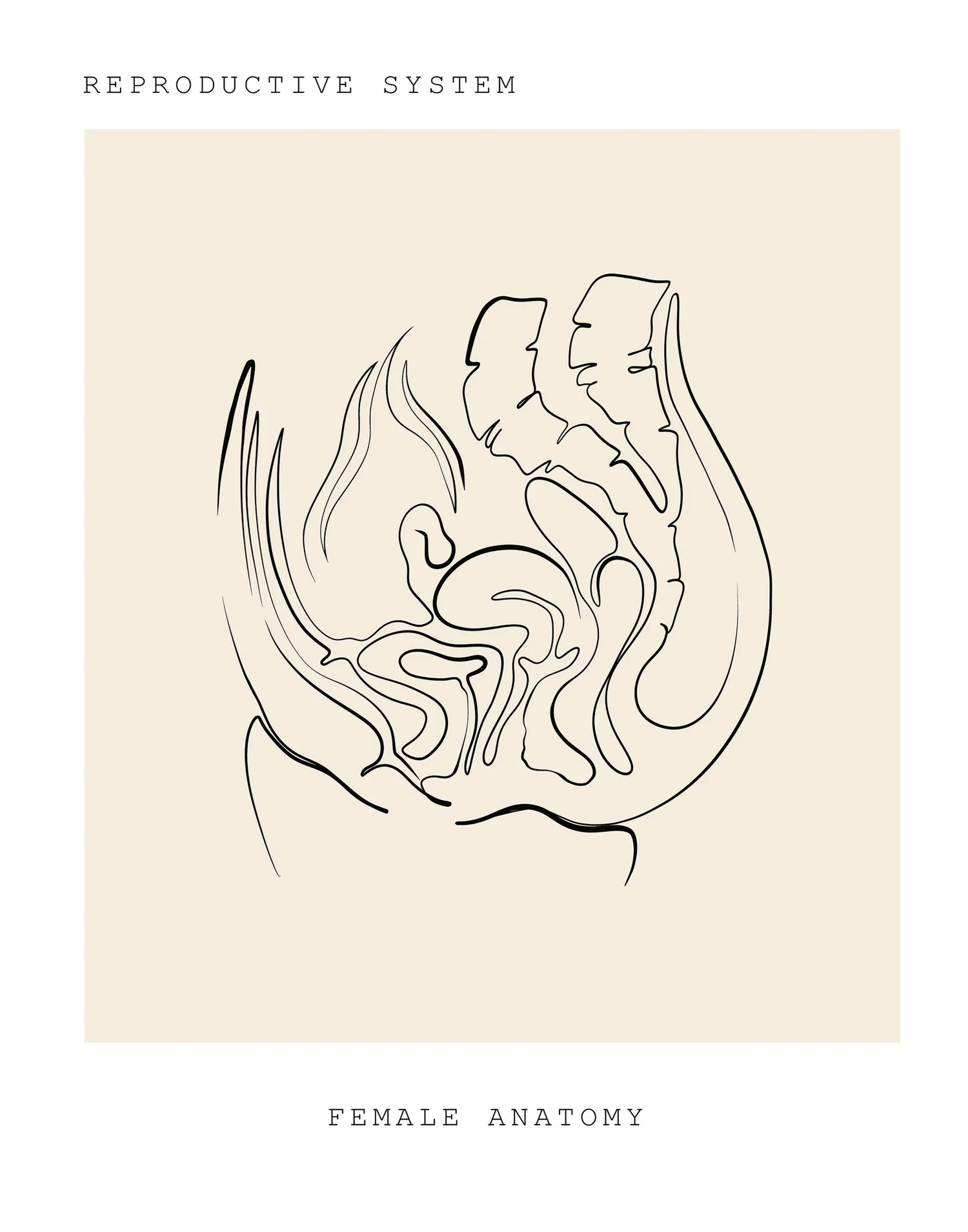
Anatomy line art by Khanali Anatomy, used with permission.