

Leaking with coughing, lifting or running
Leaking when you cough, sneeze, laugh, jump or lift is common. It is not something you have to accept because you had babies or because you are past fifty. In my experience it is often not a sign that the pelvic floor is simply weak and needs more kegels. More often the whole system, breath, abs, pelvic floor and hips, is not working together under load. That is what we assess. It is where the work usually starts. In Conroe, with a plan you actually understand.
Who this is for
The woman who crosses her legs before she sneezes. The one who stopped running or jumping at the gym and quietly switched to the bike. The lifter who leaks under a heavy bar and has been told to wear black shorts. The new mom who was handed a kegel printout and is still leaking. And the men who leak after prostate surgery, whom we see case by case when they can commit to twice a week for a minimum of four weeks.
The common mistake
Kegels, done constantly, as the only answer. Kegels help some people. If yours are not working, the pelvic floor may not be the weak link. A floor that is already holding tight is bracing to do a job it was not made to do alone. It has a hard time yielding and rebounding under a cough, so it can leak under pressure. The other mistake is holding your breath to lift. That sends all the pressure straight down onto the floor.
The reframe
The woman who leaks with a sneeze and the lifter who leaks under a bar often have a similar problem at different force levels. Pressure inside the torso spikes and the floor is not managing it well. The inner thighs, the lower abs and the glutes share that job with the pelvic floor. What we do is restore the floor's ability to lengthen. We teach you to exhale on exertion so the pressure has somewhere to go. We bring the hips and glutes back into the work.
What a first visit looks like
Your first visit is a 60-minute hands-on evaluation, not a treatment session. We want to understand what is driving the leaking before we treat it. Your therapist watches how you breathe, how your belly and ribs move, what your floor does when you cough, and how you lift. No internal exam. Everything is movement-based with your clothes on. Then we sit down together and explain what we found. We discuss strategies you can begin doing at home that day. Then we help you plan out how to get back to feeling like yourself again. You will not be rushed, dismissed, or sent home with a generic printout. We don't do guesswork. Every follow-up starts in the recovery room. Your therapist has planned a calm, welcoming recovery experience for your transition into the clinic, where you decompress, settle your nervous system, and relax your muscles. That prepares you to get the most out of the hands-on and movement-based portions of your session.
How long it usually takes
The number of visits varies. It depends on how long this has been going on and how consistently you do your part at home. Most people feel significantly better in three to four visits. Strength is usually back in about eight. We typically see you once or twice a week. Leaking that started recently often changes within the first few visits. Leaking that has been there for years often needs closer to ten for the new pattern to hold. Your home habits are part of the Victory Method. Five minutes a day, as non-negotiable as brushing your teeth. That is what carries it.
What it costs
The evaluation is $225 and follow-ups are $199. Cash-based and out of network; HSA, FSA and CareCredit accepted; superbill once a physician referral is on file. No referral is needed to start. Over 600 Conroe neighbors have come through this door. More than 200 of them left five-star Google reviews, more than any other physical therapy clinic in Conroe.
When we'll send you somewhere else
One evaluation is the right place to start. If we see any medical red flags, we will refer you out rather than recommend treatment. Leaking that comes with pain or burning, blood, or a sudden change you cannot explain gets a referral to a urologist or pelvic health physician. We work alongside them, not instead of them.
Questions people ask
Do I need an internal exam to treat this? No. We treat the pelvic floor through breath, movement and the muscles around it.
Will I have to stop lifting? Usually not. We work on how you breathe and brace under the bar, and for many people the weight comes back up as that improves.
Is this a weak floor or a tight floor? Often tighter than people expect. A floor that cannot let go has trouble catching a cough. The evaluation helps us tell which it is for you.
Can men come for this? Yes, case by case, especially after prostate surgery, when you can commit to twice a week for at least four weeks.
What to do this week
- Notice whether you hold your breath when you lift, sneeze or climb the stairs. A held breath sends the pressure straight down onto the floor, which is often the moment the leak happens. Noticing it is the first step, and it is something we work on together.
- Know that the pelvic floor is not working alone. The inner thighs, lower abs and glutes are supposed to share the job, and when they do, the floor stops having to hold everything by itself. That is what the plan rebuilds.
- Fill out the contact form and tell us when the leaking happens.
Ready to talk? You don't need to be in crisis to get care. Tell us what's going on and we'll tell you if we're the right fit. Fill out the contact form and our team will reach out, usually the same business day.
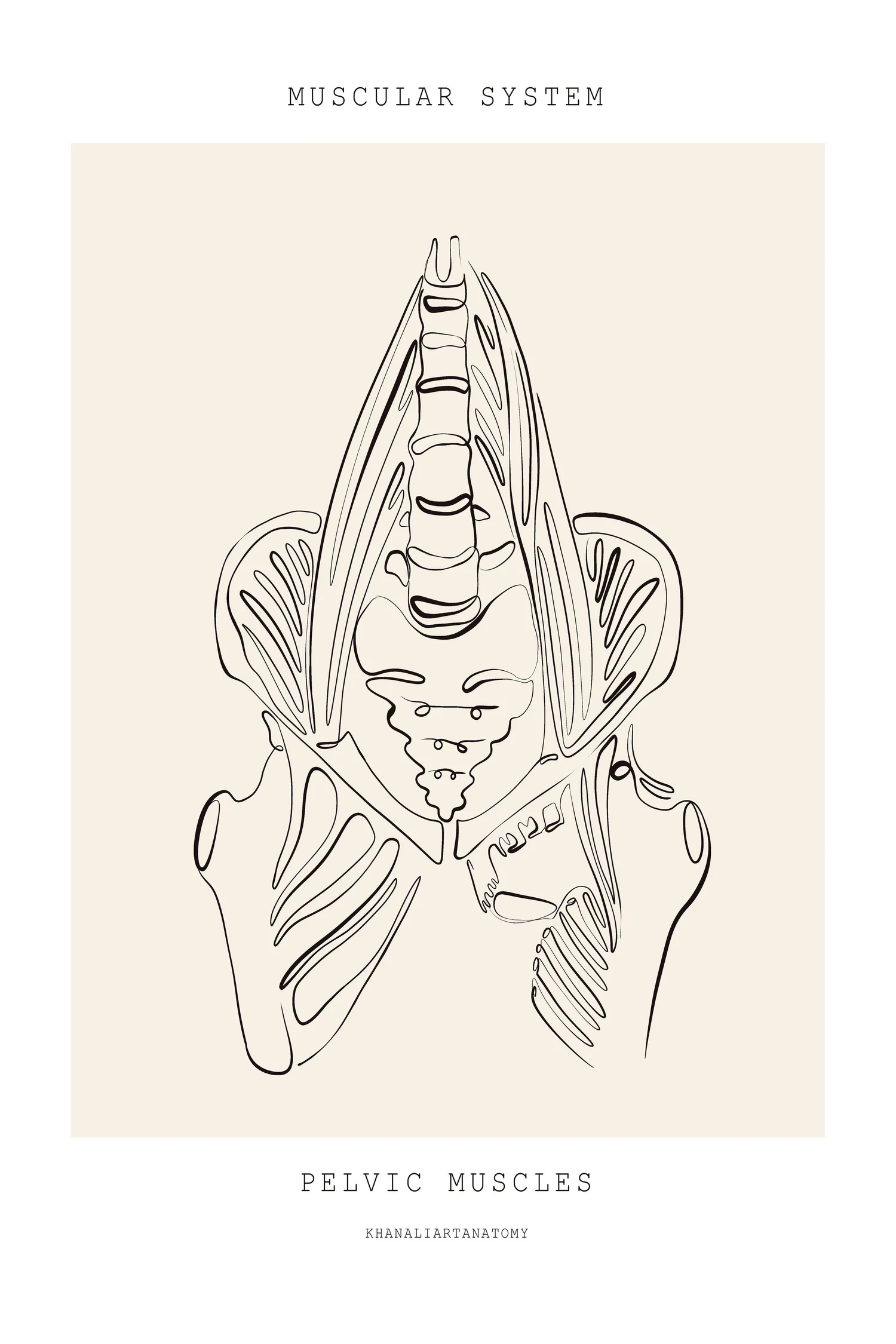
Anatomy line art by Khanali Anatomy, used with permission.